Storm-Ready Canopies: Why Tree Cutting Service Is Your Best Home Insurance
When you think of home insurance, you picture policies, premiums, and claims. But the best insurance policy for your Albury property isn’t a piece of paper. It’s a proactive tree cutting service in Albury, NSW. With the Murray region facing high-intensity storm cycles predicted for 2026, your trees could be your home’s biggest liability or its first line of defence.
The 2026 Storm Forecast for the Murray Region
Meteorologists are warning that the Border region, including Albury and Wodonga, will experience more frequent and violent summer storms in 2026. These systems bring destructive wind gusts, heavy downpours, and sudden microbursts. For homeowners, this means one thing: mature trees become dangerous projectiles.
The problem isn’t just the wind speed. It’s how your tree handles that wind. A dense, unpruned canopy acts like a giant sail. This is called the “Wind Sail” effect. When a tree has too many internal branches, thick foliage, and a solid crown, the wind has nowhere to go. It pushes against the tree with immense force, transferring torque to the trunk and roots. The result? Uprooting, major limb failure, or a trunk split that sends tonnes of timber through your roof.
Hiring a professional tree pruning service before storm season is the smartest move you can make. It’s not about removing all trees. It’s about engineering them to survive.
How Crown Thinning Prevents the Wind Sail Effect
A quality tree cutting service uses a precise technique called crown thinning. Unlike topping (which ruins tree structure), crown thinning selectively removes inner branches, crossing limbs, and excess foliage. This opens up the canopy, allowing wind to pass safely through the tree rather than slamming into it.
Think of it like a racing sailboat. A solid sail catches the wind and moves the boat. But a tree isn’t a sailboat. You want the wind to flow through the branches. After crown thinning, the tree retains its natural shape and health, but wind resistance drops dramatically. That means less leverage on the roots and trunk. It’s a low-cost, high-return investment in home safety.
For Albury homeowners with large eucalypts, oaks, or liquidambars, this is essential. Our region’s soil, often shallow clay or rocky river flats, doesn’t hold deep root systems. A tree that catches too much wind can topple even in a moderate gust. So when you search for a professional service, look for arborists who specialise in storm-proofing, not just lopping.
When Pruning Isn’t Enough: Tree Removal Service
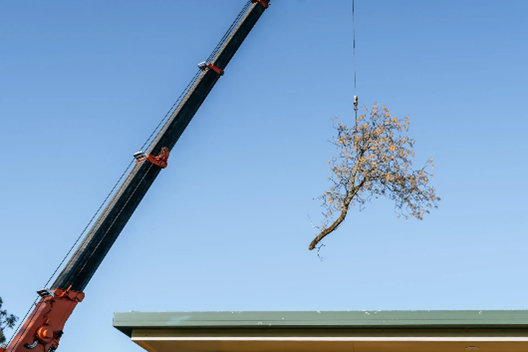
Sometimes, crown thinning won’t save a tree. If a tree has already developed structural cracks, visible decay, or a disturbed root system (from recent excavation or flooding), it’s a candidate for urgent removal. That’s where a tree removal service in Albury, NSW, becomes your best home insurance.
Signs that pruning won’t cut it:
- Large vertical cracks in the main trunk
- Fungal growth (mushrooms) at the base – indicating internal rot
- Heaving soil or lifted paving near the roots
- Dead or hanging major limbs (widow makers)
- Leaning that has worsened in the last 12 months
If you notice any of these, don’t wait for the next summer deluge. Contact a tree removal service immediately. A falling tree doesn’t just damage your home; it can cross fences, destroy a neighbour’s bedroom, or take out power lines. Your standard home insurance might cover the damage, but it won’t cover the trauma, the excess fees, or the months of repairs.
A proactive tree cutting service is your first step. But if a tree is already compromised, move straight to removal.
Real Storms, Real Damage in Albury
Think back to the November 2022 supercell that hit Albury. Trees fell across the Murray Valley Highway, roofs were torn off in Lavington, and Thurgoona lost power for days. Most of those trees looked healthy from the ground. But their canopies were too dense, acting like parachutes in 110 km/h winds. After the storm, local arborists reported that 80% of failed trees had never been professionally thinned.
You don’t want to be that statistic. An arborist can assess your property today, identify high-risk trees, and carry out crown thinning before the 2026 storms arrive. It’s cheaper than your insurance excess and far less stressful than a midnight evacuation.
Don’t Wait for the First Summer Deluge
The best time to storm-proof your trees was last autumn. The second-best time is now. In Albury, our growing season (spring to early summer) produces rapid foliage growth. By January 2026, your trees could be denser than ever. That’s why you should schedule a tree cutting service between late winter and mid-spring. This gives the tree time to seal wounds before the heat, but also reduces the canopy before the heaviest storms. A certified arborist will inspect each tree, measure crown density, check for root plate movement, and provide a written storm-readiness report. They’ll also advise on which trees need ongoing maintenance every 2–3 years.
Your home is your biggest asset. Don’t leave it to chance. Whether you need crown thinning for storm safety or urgent removal of a hazardous tree, Curtis Tree Lopping Specialists is here for the Border community.
Contact us today to book a free on-site assessment. Our team will identify wind-sail risks, provide a fixed-price quote, and schedule work before the 2026 storm season hits.